


Hungarian researchers have played an important part in an international breakthrough in quantum chemistry. Örs Legeza, Scientific Adviser at the HUN-REN Wigner Research Centre for Physics, and Andor Menczer, a PhD student at Eötvös Loránd University (ELTE), contributed to the development of a new computational approach that makes it possible to tackle quantum-chemical problems previously regarded as too complex and computationally too expensive to solve. The results were published in the Journal of Chemical Theory and Computation The study was carried out through an international collaboration involving the HUN-REN Wigner Research Centre for Physics, NVIDIA, Sandbox AQ, the Technical University of Munich, and Pacific Northwest National Laboratory (PNNL). The researchers showed that GPU accelerators developed for AI workloads are not only fast, but also capable of delivering the accuracy required for demanding quantum-chemical calculations.
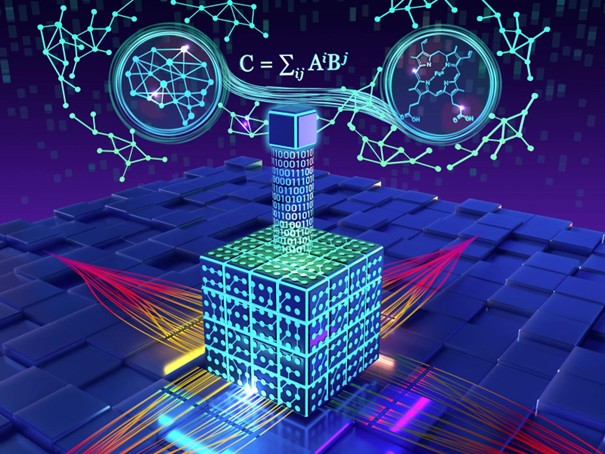
In this study, the team exploited the capabilities of the NVIDIA Blackwell architecture, which is well suited to handling simulations of this complexity. The researchers employed a mixed-precision computational approach: where approximation was sufficient, they used faster, lower-precision calculations, while reserving maximum precision for the critical steps.
The method is based on the Density Matrix Renormalisation Group (DMRG) approach, which has been further developed by Örs Legeza. This method enables the study of systems containing large numbers of interacting electrons. Such problems are particularly important in fields such as catalysis, bioinorganic chemistry, and the study of semiconductor behaviour.
The researchers’ findings show that hardware originally designed for artificial intelligence can also address some of the most difficult problems in quantum chemistry with high accuracy. More specifically, the work demonstrates that advanced GPU hardware can be combined with state-of-the-art scientific computing methods to achieve chemical accuracy in strongly correlated quantum-chemical calculations at the frontier of computational feasibility.
In the longer term, this could mean that quantum-chemical calculations that currently require supercomputers may become routine on next-generation accelerator platforms. This, in turn, could accelerate the development of new catalysts, improve predictions for magnetic and electronic materials, and support advances in materials science and related areas.
“Our study shows that AI-oriented hardware can do more than provide speed—it can also power chemically accurate, strongly correlated quantum chemistry at the frontier of what is computationally feasible,” said Sotiris Xantheas, a computational chemist at PNNL.
“By demonstrating that mixed-precision DMRG with emulated FP64 can reach chemical accuracy for challenging active spaces, we’ve opened a practical path to using next-generation Blackwell systems for problems in catalysis, bioinorganic chemistry, and materials science that were previously far harder to access,” said Örs Legeza.
The research was supported by the Hungarian National Research, Development and Innovation Office (NKFIH), the Hans Fischer Senior Fellowship Programme of the Technical University of Munich, and the SPEC initiative of the US Department of Energy.
Original press release: https://www.pnnl.gov/news-media/ai-accelerators-deliver-accurate-models…


