


Under the leadership of Ádám Gali, a researcher at the HUN-REN Wigner Research Centre for Physics, a study published in the journal Nature Materials presents the development of a new quantum sensor.
One of the most tangible branches of quantum technology is quantum sensing. A quantum sensor uses a well-controlled quantum system—often an atomic-scale defect in a solid—whose spin state responds exquisitely to its environment. By reading out that response with optical techniques and microwave control, quantum sensors can detect signals that are too small, too local, or too noisy for conventional probes.
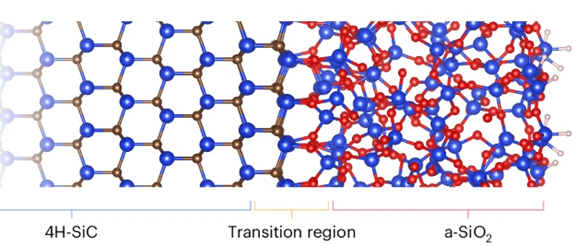
Illustration: Model of the SiC surface Reference Pei Li et al.
Where can quantum sensors make a difference?
Quantum sensors are especially attractive when nanoscale, local information is required:
• mapping magnetic fields and currents at micro- and nanoscale (materials, electronics diagnostics),
• local thermometry and strain sensing in microelectronic structures,
• biomedical sensing, including detection of paramagnetic species and radicals, and bioimaging concepts,
• quantum NMR (qNMR): sensing nearby nuclear spins for chemical and biochemical analysis.
Why look beyond diamond NV centers?
The nitrogen-vacancy (NV) center in diamond is a flagship platform for room-temperature quantum sensing. In biological environments, however, it can be disadvantageous that efficient excitation typically relies on green light (around 532 nm), where water and many organic molecules absorb strongly—enhancing background fluorescence and heating.
Silicon carbide (SiC): a bioinert semiconductor with near‑infrared optics
Divacancy defects in 4H silicon carbide (4H‑SiC) provide spin qubits that can operate at room temperature while being compatible with near‑infrared optical schemes. This matters for bio-applications because near‑infrared light typically penetrates better and produces less autofluorescence. SiC is also an industrially mature, wafer‑scale semiconductor, making it attractive for scalable device integration.
The key is the surface: enabling shallow qubits to act as sensors
For sensing external targets, the qubit must sit only a few nanometres below the surface. That proximity is exactly where performance often degrades. The central insight of the Nature Materials study is that surface chemistry can be engineered to stabilize shallow SiC qubits in a way that is directly useful for sensing.
Adam Gali’s hypothesis: alkene chains to protect and functionalize the surface
The main concept of the work was Adam Gali’s (HUN‑REN Wigner RCP) hypothesis: an alkene‑chain organic monolayer can cover the SiC surface, stabilizing shallow divacancy qubits while providing a route to application‑specific functionalization. In this view, the surface becomes a designed interface between the quantum sensor and its biological/chemical environment.
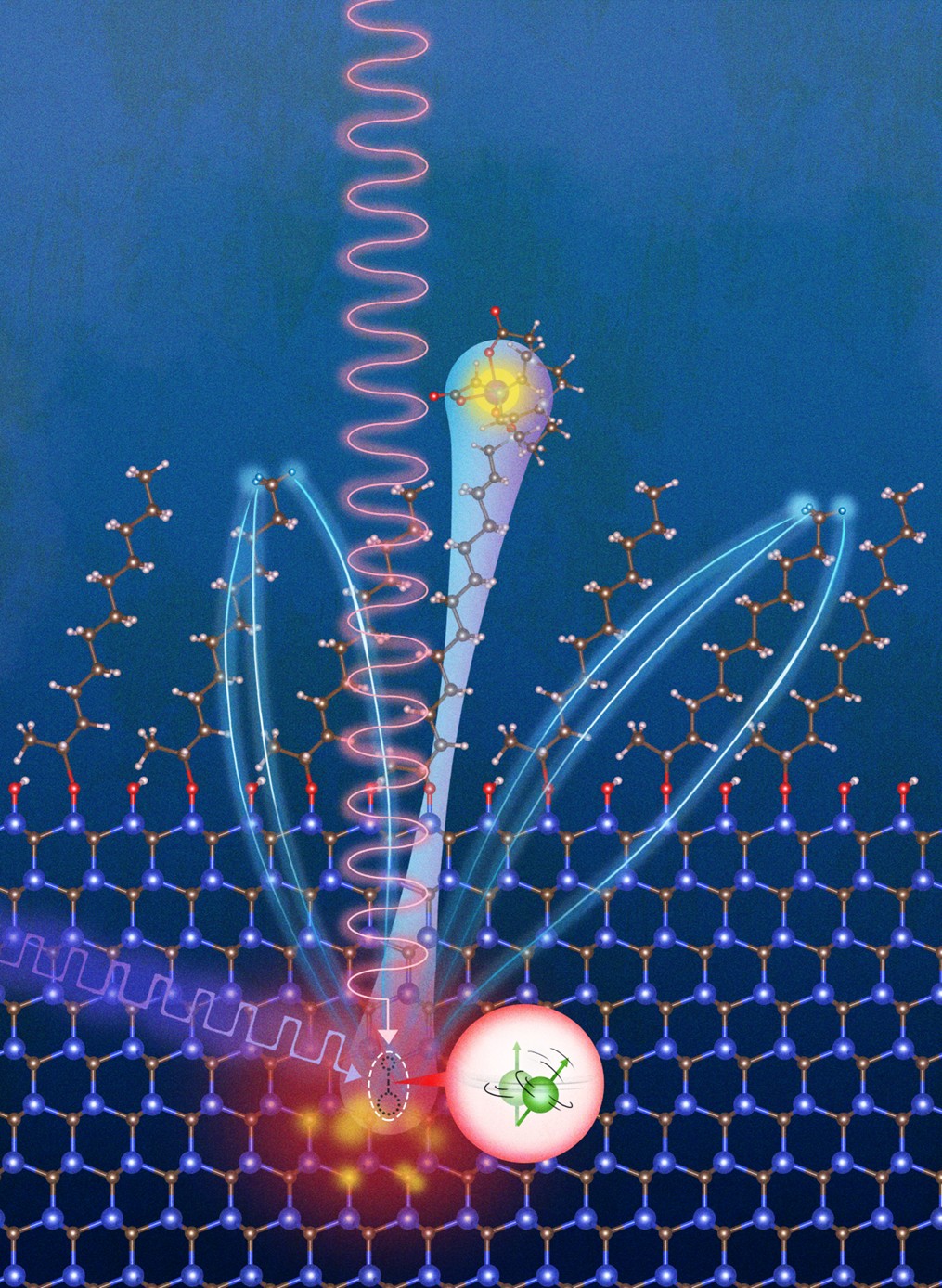
Illustration: SiC quantum sensor with innovative carbon-chain surface termination. Reference Pei Li et al.
What did the authors demonstrate?
The paper emphasizes electron‑spin relaxometry as a sensing modality sensitive to nearby paramagnetic species. Across theory and experiment, the results indicate stable operation of shallow divacancies with sensing‑relevant performance. The study reports an experimentally inferred sensitivity on the order of ~56 nT/√Hz, and discusses an outlook of ~13 nT/√Hz with isotope engineering. The optical scheme is shifted into the near‑infrared (914 nm pumping and detection in the 1.2–1.5 μm band are described).
International collaboration: Wigner concept and leadership, USTC experimental validation
According to the author-contribution statements, Adam Gali conceived the main concept and led the scientific project, while researchers at the University of Science and Technology of China (USTC) carried out the experimental demonstrations and analysis. This division of work illustrates how a surface‑chemistry hypothesis can be translated—through close collaboration—into validated sensor operation.
Outlook
Together, SiC divacancy qubits and alkene‑based surface engineering point toward a more device‑like quantum sensor platform: near‑infrared optics suitable for biological environments, and compatibility with semiconductor manufacturing. If surface functionalization becomes routine and application‑specific, such sensors could evolve from lab demonstrations into practical tools for diagnostics, chemistry, and materials science.
Forrás / Reference
Pei Li et al. Non-invasive bioinert room-temperature quantum sensor from silicon carbide qubits. Nature Materials (2025). DOI: 10.1038/s41563-025-02382-9.


