


Making a good decision is not enough: it is also important to assess how certain that decision is. A research group led by Gergő Orbán at the HUN-REN Wigner Research Centre for Physics, working with Argentinian partners, has developed a method that improves how deep-learning systems represent uncertainty. The findings could make AI-based image processing more reliable, which may be particularly important in areas such as medical imaging, while also helping researchers gain a more precise understanding of human vision. The results were published in IEEE Transactions on Pattern Analysis and Machine Intelligence.
The research lies within the field of NeuroAI, which explores parallels between the workings of the nervous system and artificial intelligence. The aim is twofold: a better understanding of how the brain works may help researchers develop more effective machine intelligence, while studying artificial systems can, in turn, generate new ideas for neuroscience.
In this study, the researchers asked how an artificial intelligence system could more accurately indicate how certain it is about the inferences it draws from an image. This distinction matters because there is a substantial difference between a system selecting one option that is only marginally more likely than several similar alternatives and one that can rule out the other possibilities with high confidence.
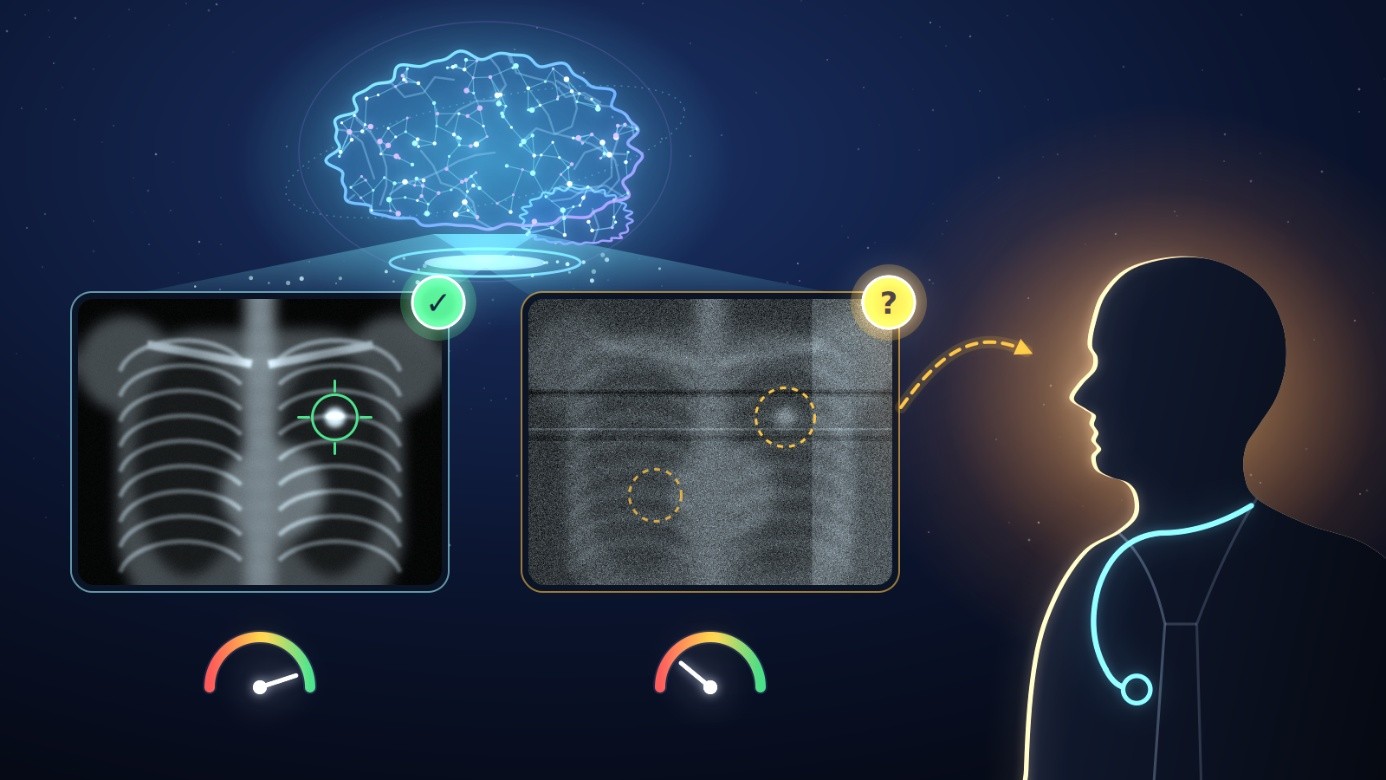
When artificial intelligence becomes overconfident
The study focused on variational autoencoders, or VAEs. These are deep generative models that learn to capture the essential features of an image in a compact internal, or latent, representation and can then use this representation to reconstruct the image. One of their appeals is that they can, in principle, estimate not only a best interpretation of their input but also the uncertainty associated with it.
The researchers found, however, that conventional VAEs can produce inconsistent uncertainty estimates under several common computer-vision conditions. Problems may arise, for example, when the contrast of an image changes, when an image is noisy or corrupted, or when the system encounters an image that differs substantially from those seen during training.
The Hungarian–Argentinian research team therefore extended the model with an approach inspired by classical computer vision. They called the new version the Explaining-Away Variational Autoencoder (EA-VAE). The model incorporates an additional global scaling latent variable, which helps it distinguish whether a change in an image is related to the object being represented or is instead due to a global factor such as a change in overall contrast or brightness. The method was tested across several types of image data, and the EA-VAE consistently outperformed standard VAEs when their uncertainty estimates were contrasted.
A computational principle also found in the brain
A particularly interesting aspect of the study is that the EA-VAE was found to recruit a computational mechanism known as divisive normalisation. Put simply, this means that the response of an individual unit is regulated relative to the combined activity of other units in the system. Divisive normalisation is a widespread computational motif in biological neural networks and is particularly well established in sensory and visual processing.
In other words, the researchers did more than improve the performance of an artificial intelligence model: the solution that emerged relies on a computational principle that is also widely observed in the biological nervous system.
What could the practical benefits be?
Reliable uncertainty estimation is particularly important in error-sensitive applications, where an incorrect but overly confident decision could have serious consequences. When analysing a medical image, for example, it is not enough for an algorithm to identify a possible abnormality; it also matters how confident the system is in that assessment. A well-calibrated model could indicate when an image is unusual, ambiguous or difficult to interpret and therefore requires review by a human expert.
The same principle could benefit any image-processing system that has to cope with changing contrast or illumination, noise, corrupted data or images that differ from those encountered during training.
The research therefore points in two complementary directions: towards more reliable artificial intelligence and towards more accurate computational models of biological vision.


