


2023
Fabrication of picowell arrays on polymer surfaces with a 10.5 MeV N4+ ion microbeam. — Handling of picoliter-to-nanoliter-scale volumes and objects has increasing importance in life sciences. This is the volume scale of cell extractions and individual living cells. A method of generating a picoliter-scale device by direct writing of picowell arrays on a ZEONOR™ copolymer surface with high-energy medium-mass ion microbeam was devised. Arrays of various microstructures were written in the sample using a microbeam of 10.5 MeV N4+ ions at various implanted ion fluences. The best array was obtained by implantation of annuli of 10 and 11 µm of inner and outer diameters with a fluence of 7.8·1012 ions/cm2.
An array of 9 x 9 picowells, in the form of chalice-like structures, was obtained and tested. The implanted surface structures were studied by optical and atomic force microscopy (AFM). The average volume of the picowells was 820 femtoliter (fl), ideal to host a single living cell. AFM image of a picowell is shown in Figure 1.
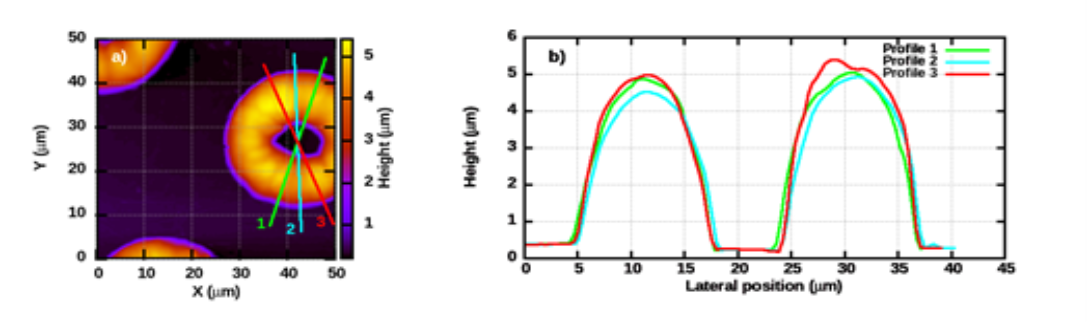
Figure 1. Height-contrast AFM image (A) of part of array J, and topographical height profiles of a picowell (B) in it. Sections of the picowell where profiles were extracted are indicated on the left panel.
AFM microhardness measurements showed that the implanted toroidal wall of the picowell had the same hardness as the unimplanted parts of the sample. Applicability of the ion microbeam written picowell array in biomedical single-cell assays was demonstrated by placing individual cancer cells with the cell-cycle reporter fluorescent construct in some of the wells, and detecting their fluorescence signal. An example is presented in Figure 2, where microfluorescence from a HeLa Fucci cell placed in a picowell can be seen.
By changing the parameters of the fabrication, such as ion species, energy, fluence and ion microbeam size, reducing picowell volume down to about 100 fl and increasing the volume up to about 50 pl appear feasible. Thus direct writing of such structures using medium-to-high-energy ion microbeams can compete with direct writing by laser beam. A clear advantage of ion microbeam writing over laser beam writing is the better controllability in depth, allowing for fabrication of three-dimensional structures.
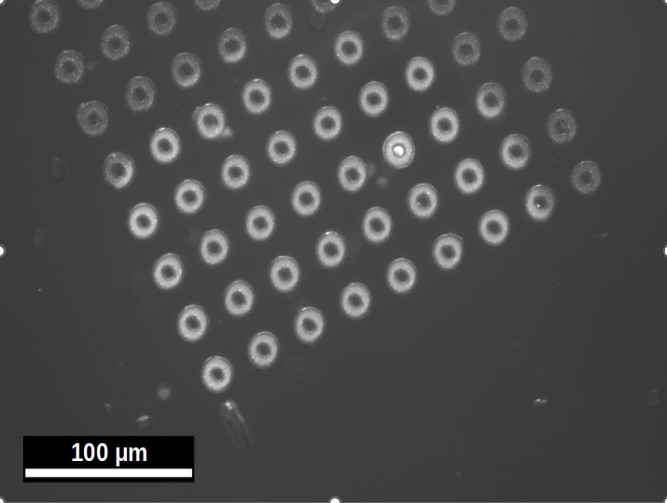
Figure 2. A Fucci cell emitting strong fluorescent signal is seen in the targeted well. A 43HE DSRED filter was used.
Moreover, the recent introduction of ion nanobeam facilities with typical lateral beam sizes in the 200 - 400 nm range further improve lateral resolution of the ion beam irradiation technique. Although ion beam accelerators are normally not easily accessible, the proposed method has some clear advantages. First, it is a one-step fabrication. Second, it is a fast method: fabrication of an array can take typically tens of seconds and may take a maximum of a couple of minutes. The method permits a very quick and flexible design of the picowells. Third, besides the polymer used in these experiments, other materials, e.g. glasses can also be used, although higher fluences (and hence longer irradiation times) may be necessary. Finally, the fabricated surface structures can be also applied as templates for PDMS casting to obtain a negative replica. When a positive replica is needed, the PDMS stamps could be used for UV replication, obtaining by this way the exact copy of the fabricated structures.
Plastic deformation of microsamples. — Understanding how irradiation affects the microstructure and mechanical properties of various components is extremely important for nuclear applications. Investigations of bulk samples are hindered by the facts that neutron irradiation requires long exposure times and leads to the activation of the sample. For this reason ion irradiation is often used as an alternative since it was shown that the resulting defect structure is comparable to that caused by a neutron flux. However, the limited penetration depth of ions and the resulting inhomogeneity of the defect structure poses a significant challenge for the application of traditional tools of mechanical testing. Therefore, micromechanical approaches (such as nanoindentation or micropillar compression) have recently been used that exploit the fact that ion induced radiation damage can still be nearly homogeneous at microscopic scales.
Plastic deformation of microsamples is characterised by large intermittent strain bursts caused by dislocation avalanches. Here in collaboration with Department of Materials Physics, Eötvös Loránd University we investigate how ion irradiation affects this phenomenon during single slip single crystal plasticity [2]. For this purpose, in situ compression of Zn micropillars oriented for basal slip was carried out in a scanning electron microscope (SEM). The unique experimental setup also allowed the concurrent recording of the acoustic emission (AE) signals emitted from the sample during deformation. The results are summarized in Figure 3.
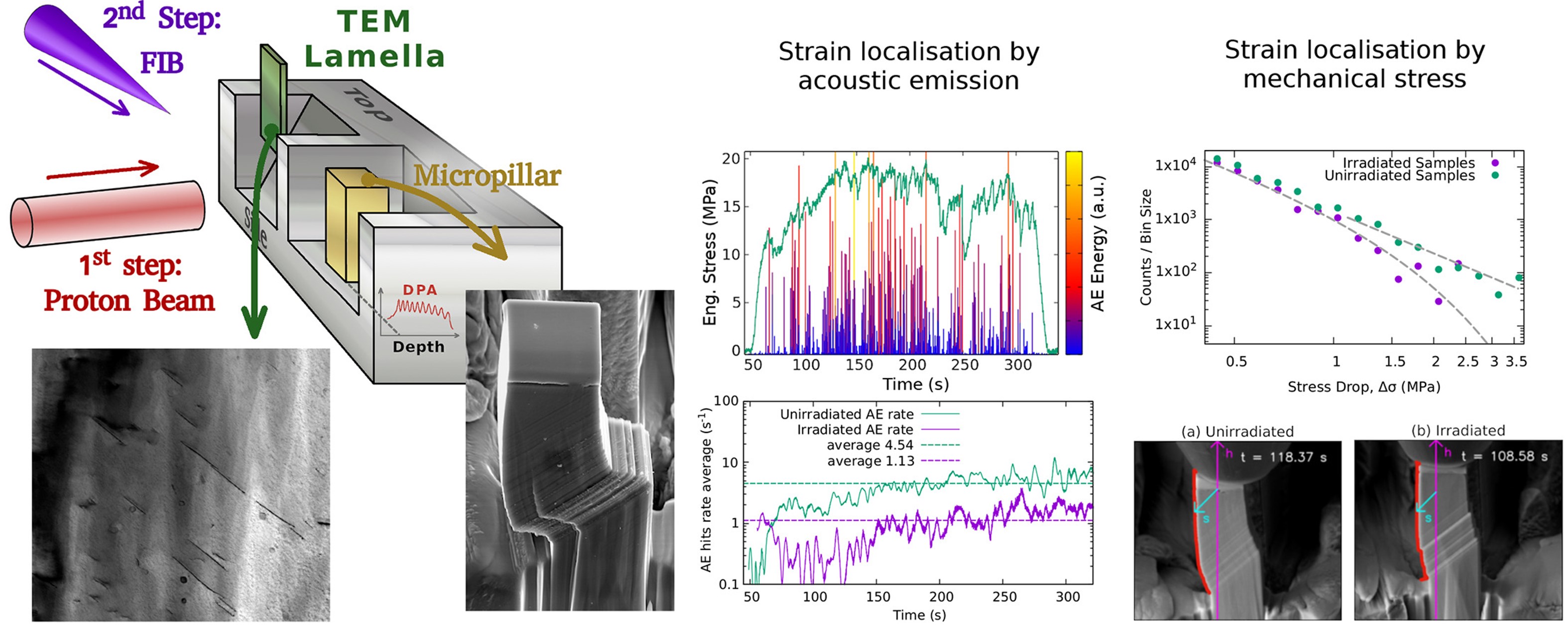
Figure 3. Schematic draw of the geometrical arrangement of the experiment, TEM image from an irradiated area showing the cross sections of irradiation-induced dislocation loops. Compression experiments were carried out on pristine and irradiated micropillars, SEM images show various micropillars. Acoustic emission was recorded concurrently during deformation. Strain was localized by acoustic emission and mechanical stress both for unirradiated and irradiated samples.
Irradiation introduced a homogeneous distribution of basal dislocation loops that lead to hardening of the sample as well as strain softening due to dislocation channeling at larger strains. Under the loading conditions imposed, the intensity of strain bursts was found to decrease during channeling. The concurrently recorded AE events were correlated with the strain bursts and their analysis provided additional information of the details of collective dislocation dynamics. It was found that the rate of AE events decreased significantly upon irradiation, however, other statistical properties did not change. This was attributed to the appearance of new type of dislocation avalanches which is dominated by short-range dislocation-obstacle interactions that cannot be detected by AE sensors.
References:
[1] Bányász I., Rajta I., Havránek V., Mackova A., Laki A. J., Kellermayer M. S. Z., Szittner Z., Kurunczi S., Novák Sz., Székács I., Horváth R., Fried M., Nagy G. U. L. Design, fabrication, and characterization of picowell arrays on cyclic olefin copolymer surfaces generated with a 10.5 MeV N4+ ion microbeam APPLIED PHYSICS LETTERS 123 : 5 Paper: 053701 , 6 p. (2023). DOI: 10.1063/5.0155681
[2] Ugi D., Péterffy G., Lipcsei S., Fogarassy Z., Szilágyi E., Groma I., Ispánovity P.D.: Irradiation-induced strain localization and strain burst suppression investigated by microcompression and concurrent acoustic emission experiments. MATERIALS CHARACTERIZATION 199 Paper: 112780, 11 p. (2023). DOI: 10.1016/j.matchar.2023.112780


